
React vs Angular vs Vue vs Vanilla JavaScript – Anak
Introduction
The world of the front end is dominated by 3 technologies –
Angular,
 React and
 Vue. Increasingly, however, there is talk of a triumphant return of

plain JavaScript (a.k.a “Vanilla JavaScript”).
This can be seen for example in the

Bootstrap approach, which in version 5 dropped jQuery and announced
the migration to pure JavaScript.
However, this does not make it any easier to choose between the
available options, and the competition between technologies and their
supporters (who are often more like fanatics) sometimes takes the form
of a real war.
What would a front-end look like in a fantasy world?

Watching these tribal battles, one gets the impression that the most
important question any programmer has to answer is:
What technology is the best?
Contrary to appearances, the answer to this question is extremely
simple:
There is no such thing as “best technology”
Why? Because all of the above options are great and any of them can
help you create a fantastic project.
Both Angular, React, Vue and pure JavaScript are very mature and
stable technologies, with huge and active communities. Each of them
provides all the necessary tools and support needed in modern web
development.
Therefore, the question you should ask is:
Which solution will be the most reasonable for me, with the project
I am working on and with my resources?
Much better.
The answer to this question is also simple:
Choose the solution that will lead you to your goal (i.e. build
the specific project you are working on) in the most efficient
way
Where to start?
Now let’s leave these very general questions and get down to
business.
Typically, technologies are judged in such categories like:
- popularity
- job market demand
- community and development
- performance
- flexibility
- maturity
- tooling
But let’s be honest – each of the technologies mentioned in this
article performs very well in all of these categories.
However, there is one thing where these technologies differ
significantly from each other and that is crucial when choosing
first:
Learning curve

Why is this issue crucial?
Because if you are already a seasoned developer technology is of
secondary importance to you. With appropriately advanced skills, you
are able to create a high-quality project and solve any problem,
regardless of whether you work in Angular, React, Vue or plain
JavaScript.
However, the problem is how to get to that level. And that is why
the learning curve is crucial, because it determines how efficiently
our technology learning progresses.
Assume the following scenarios:
- You are a beginner without knowing the basics of web development
- You already know HTML, CSS and the basics of plain JavaScript
-
You already know Bootstrap well, and you have at least an
intermediate level of knowledge of plain JavaScript - You are a seasoned developer with advanced knowledge of JavaScript
Now let’s consider them step by step.
Scenario 1 – You are a beginner without knowing the basics of web
development
At this point, you shouldn’t think about frameworks and
libraries at all. You must first build a solid foundation and learn
the basics of web development well.
Recommended choice: Start by learning HTML, CSS,
and the basics of JavaScript.
If you try to skip this stage and start, e.g. with React, you will
get discouraged from programming very quickly. It’s like writing an
essay in a foreign language without knowing even the basic
vocabulary and grammar.
Our basic courses are the best place to start
your coding adventure.
They are free, easy to follow and will allow you to learn the
necessary basics to work with more advanced tools like MDB.
Get started
Scenario 2 – You already know HTML, CSS and the basics of plain
JavaScript
You’re on the right track, but it’s still too early for solutions
like Angular, React or Vue. You should significantly strengthen your
knowledge of plain JavaScript and become familiar with Bootstrap –
preferably its latest, fifth version.
Recommended choice: Get started with MDB 5
Standard, which is made of pure JavaScript and the latest Bootstrap
5.
MDB 5 Standard is an extremely powerful (and at
the same time extremely easy to use) tool, thanks to which you
will not only improve your knowledge of pure JavaScript, but
also learn concepts such as responsive web design and good web
development practices.
Get started
After downloading and installing MDB Standard, you can start
learning our tutorials right away. In the first one, you will
learn how to create an impressive, responsive landing page.
Scenario 3 – You already know Bootstrap well, and you have at
least an intermediate level of knowledge of plain
JavaScript
This is a good time to start your adventure with frameworks. The
knowledge you have and a solid foundation in plain JavaScript will
allow you to smoothly implement more advanced technologies.
Recommended choice: Get started with Vue & MDB Vue.
Angular and React requires a deep level of Javascript knowledge and
experience to hand decision making regarding third-party libraries.
Additionally, many companies are rapidly switching to Vue as it has
the most straightforward learning curve as compared to Angular and
React.
Vue provides higher customizability and hence is easier to learn
than Angular or React. Further, Vue has an overlap with Angular and
React with respect to their functionality like the use of
components. Hence, the transition to Vue from either of the two is
an easy option.
MDB Vue will help you smoothly enter the world
of frameworks and libraries. Thanks to it, you will learn how to
fully use the potential of Vue and gain additional tools that
will further improve your work and increase the skills of modern
web development.
Get started
Advanced comparison
After scenario 3, the “learning curve” is no longer a key issue
when choosing a technology.
Assuming you are a seasoned developer with advanced JavaScript
knowledge, we can consider each technology in detail in the following
categories:
- Designation
- Code Style
- Performance
- Flexibility
- Tooling
- Mobile
- Maturity
- Support
- Usage
- Works demand
- Popularity
Designation
Meant to build whole applications.
Focused on building user interfaces.
Focused on building user interfaces.
Code style
How readable and intuitive is the code and conventions of the
framework?
With Angular the official site provides example code in
several languages; JavaScript, TypeScript, and Dart, though
TypeScript is the most commonly used. As per styles, Angular
utilizes Sass.
React uses JSX (a simple JavaScript that uses HTML quoting).
You can also use HTML tag syntax to render subcomponents, or
write in good old-fashioned JavaScript, meaning you have
flexibility as you code, either way.
Vue.js uses an HTML-based template syntax that allows you to
declaratively bind the rendered DOM to the underlying Vue
instance’s data. All Vue.js templates are valid HTML that
can be parsed by spec-compliant browsers and HTML parsers.
If you are familiar with Virtual DOM concepts and prefer the
raw power of JavaScript, you can also directly write render
functions instead of templates, with optional JSX support.
Performance
Package size
Library size (over the network):
-runtime.js (runtime) 1.05 kB
-polyfills.js (polyfills) 59.6 kB
-main.js (main) 172 kB
Together: 232,65 kB
Library size (over the network / uncompressed): 32.5KB /
101.2KB
Library size (over the network / uncompressed): 31KB /
84.4KB
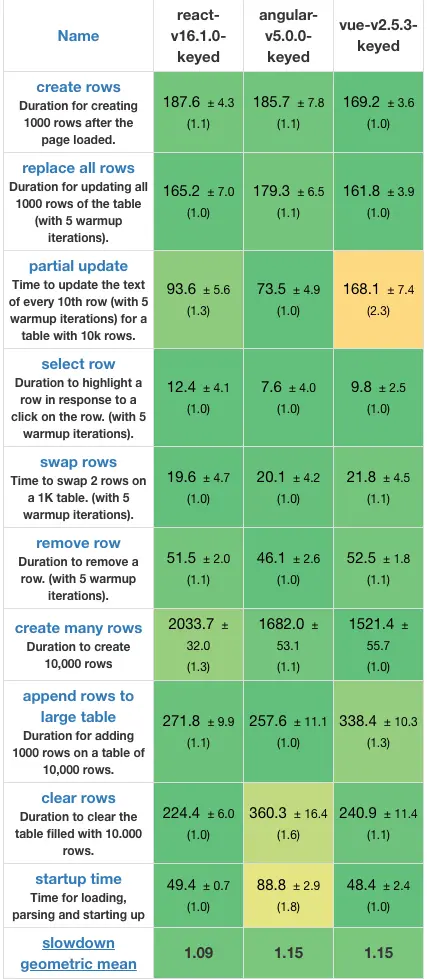
How well-performing are apps built with the framework?
Performance benchmarks vary for some use cases — that said, each of
these frameworks offers broadly similar performance. You can find
very interesting comparisons in this
post.
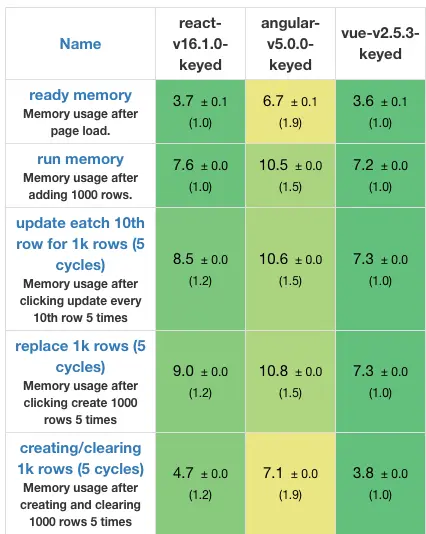
How big is the footprint of the framework with regards to package
size and memory usage?
Duration in milliseconds ± standard deviation (Slowdown = Duration /
Fastest)
Memory allocation in MBs ± standard deviation
Source:
JS framework benchmark
Flexibility
How many features is the framework offering out of the
box?
It’s an all-inclusive framework that provides more in the
box than React or Vue.
Because it’s focused on building UI, you’ll likely need to
extend react with 3rd party libraries.
It’s not as all-inclusive as Angular but it offers more out
of the box than a react.
Tooling
What tools are available for the framework?
All three frameworks provide CLIs. These CLIs make it easy to create
a new project, support local development and prepare for deployment.
The most capable CLI of the three, it furthermore offers a
lot of built-in features, which are missing in competitors
out of the box. Yet, the number of available plugins is huge
and still growing.
There are lots of great choices for fulfilling almost any
requirement.
Although it has fewer plugins and tools available, there is
a sufficient number of plugins for most common cases. Taking
into account the rapidly growing community of Vue, new
plugins are released on a daily basis.
Note:All three frameworks have a great support
within code editors like Visual Studio Code or Atom. However to get
the best experience you will have to install the appropriate
extensions.
Mobile
Does it offer a way to build native mobile applications?
NativeScript doesn’t require Angular, but
it’s even better when you use it. NativeScript features deep
integration with Angular, the latest and greatest (and
fastest) Angular framework.
Alternatively:
Ionic is a framework that allows us to
develop mobile apps and websites using web technologies –
HTML, CSS and Javascript basically. The app on a mobile
device is running inside a WebView, but of course, you don’t
see a navigation bar inside that app later! It looks and
feels like a regular app, and can be installed from the app
store of course.
With React Native, you don’t build a
“mobile web app”, an “HTML5 app”, or a “hybrid app”. You
build a real mobile app that’s indistinguishable from an app
built using Objective-C or Java. React Native uses the same
fundamental UI building blocks as regular iOS and Android
apps. You just put those building blocks together using
JavaScript and React.
Vue.js is a lightweight framework for building engaging user
interfaces.
NativeScript powers cross-platform (truly
native) mobile apps, using the web skills you already know.
Combined they are a fantastic pair for developing immersive
mobile experiences.
Maturity
How mature is the framework?
While the AngularJS (the old one) was initially released in
October 2010, the new Angular was introduced in September
2016.
Initially released in March 2013.
s the youngest, initially released in February 2014.
Support
Long-term support and migrations:
According to an Angular team blog
post,
their major releases are scheduled every six months.
Starting from Angular 4 the team has announced that each
version will be supported for at least one year beyond the
next major version release. In most cases updates are easy
and supported by migration tools (if needed).
React’s API is quite stable as Facebook states in their
design principles. Whenever a new API is released, there are some scripts
that help you to migrate. The React team wrote a blog post
about their versioning scheme. When they add a deprecation
warning, they keep it for the rest of the current release
version before the behavior is changed in the next major
version.
The Vue Team
states
that whenever a new major version is released, the previous
major becomes LTS for 18 months.
How big is the team behind the framework?
Originally created by Google, there currently are 758
contributors on GitHub.
React seems to have the biggest team with 989 contributors
on GitHub.
Though the community is growing, it is not currently as
established as or as big as the others counting 215
contributors on GitHub.
Is there a company or organization that owns the
framework?
As already noted, Angular and React are supported and used by big
companies. Facebook, Instagram, and Whatsapp are using it for their
pages. Google uses it in a lot of projects: for example, the new
Adwords UI was implemented using Angular & Dart. Again, Vue is
realized by a group of individuals whose work is supported via
Patreon and other means of sponsorship. You can decide for yourself
whether this is a positive or negative.
Usage
Typical end user:
Focused on the application which makes it popular with
enterprises.
Popular within startups and smaller organizations.
Popular within startups and smaller organizations.
Companies using these frameworks:

Google

PayPal

Microsoft

AT&T

WWF

Airbnb

Uber

Twitter

Pinterest

Codecademy

9GAG

Netflix

Adobe

Xiaomi

Alibaba
Works demand
What is the current and past demand in the market for people with
certain skills? (job advertisements)
Disclaimer: values below are estimated. Due to the
ambiguity of phrases like React, values are estimated based on 5
different search results and averaged
Indeed: 17,500
LinkedIn: 82,398
Indeed: ~7,000
LinkedIn: ~20,000
Indeed ~2,500
LinkedIn: ~7,000
Popularity
Some time back there was a
fairly momentous occurrence in the JavaScript
framework world: Vue.js passed React.js in the number of people who
have ‘starred’ it on Github. Using a tool called
Star History, we can see that this measure, in particular tells a story of
React’s historical dominance being overtaken by the skyrocketing
Vue.
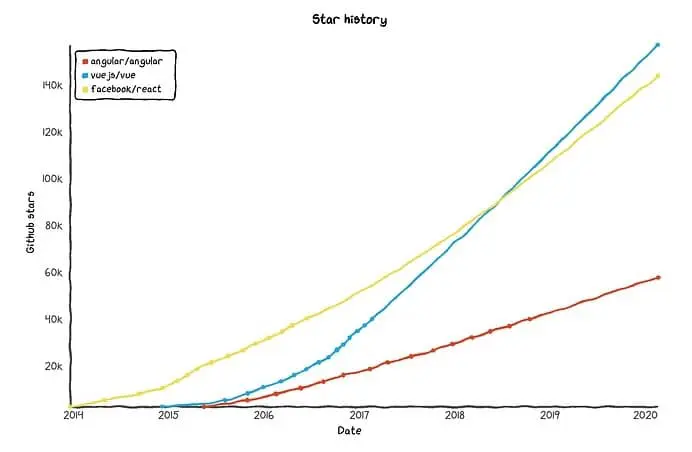
This challenge was
so exciting that one the developers
created a dedicated website to track whether
Vue has passed React yet?
Although GitHub stars can indicate an attitude that a community has
to a certain technology, it has no correlation with actual usage.
Github stars are more of a measure of the “hipness” of a project
than its actual use.
Let me visualize why this apparent correlation is wrong:
A web server that powers 38% of the Internet has 1,766 stars on
GitHub. A library that adds color to your Node console has 3,206.
pic.twitter.com/tGQJi3jYq1— Ben Sandofsky (@sandofsky)
June 15, 2018
As you can see, stars are important but they cannot be confused with
actual usage
Summary
Picking the right front-end framework is important. But far more
important is to focus on learning their shared concepts, as this
will prepare you for whatever happens to come next. Make no mistake
front-end web development like all programming specialties will
continue to change and evolve over time
Related Post